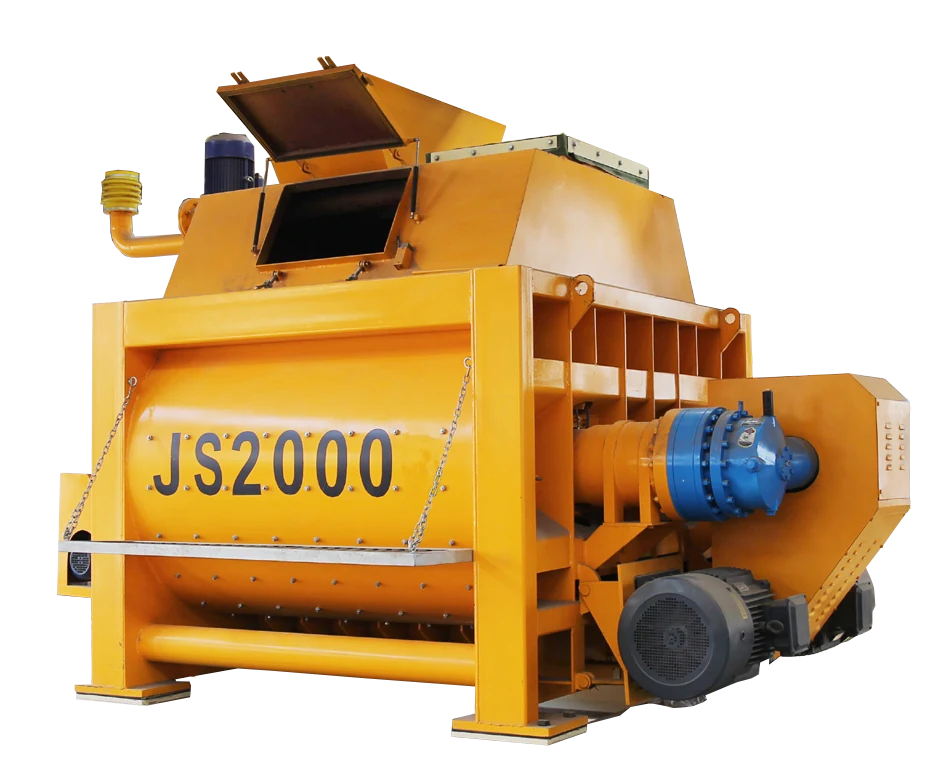
JS2000 Concrete Mixer | What Is the JS2000 and What Is Its Power Requirement?
| Discharge | 2.0 m3 |
| Productivity | 70-85 m3/h |
| Motor | 55 kW |
| Cycle | 60 s |
| Discharge Height | 3.0 m |
| Weight | ~8.2 t |
JS Series Comparison
| Parameter | JS500 | JS750 | JS1000 | JS1500 | JS2000 |
|---|---|---|---|---|---|
| Discharge Capacity | 0.5 m3 | 0.75 m3 | 1.0 m3 | 1.5 m3 | 2.0 m3 |
| Productivity | 25-30 m3/h | 30-35 m3/h | 40-50 m3/h | 55-65 m3/h | 70-85 m3/h |
| Motor Power | 18.5 kW | 30 kW | 37 kW | 45 kW | 55 kW |
| Cycle Time | 72 s | 72 s | 60 s | 60 s | 60 s |
| Max Aggregate (peb/stone) | 40/60 mm | 40/60 mm | 40/60 mm | 40/60 mm | 40/60 mm |
| Weight | ~3.2 t | ~4.5 t | ~5.6 t | ~6.8 t | ~8.2 t |
What the JS2000 Is and Where It Fits
The JS2000 is a forced twin-shaft concrete mixer discharging 2.0 m³ per batch. It is rated at 55 kW with a 60 s mixing cycle and a practical output of 70–85 m³/h; shipping weight is ~8.2 t and the standard discharge height is 3.0 m. in our range it is the mixer fitted to the HZS120 concrete batching plant.
Two horizontal shafts run through the drum with arms arranged in a spiral, turning in opposite directions. Material is pushed up the drum walls and folded back through the fastest-moving zone in the middle, so a batch is homogeneous within one cycle. That folding action is why twin-shaft mixers handle low-slump, high-fines and fibre-reinforced mixes that a single-shaft drum mixer will ball up or blend unevenly.
What you are buying at this size is predictability rather than raw speed. The JS2000 is a standard, widely-serviced unit: wear parts are available, the gearbox is a known design, and a competent local workshop can maintain it. That matters more than a marginal difference in cycle time on a machine that runs every day for a decade.
Power Requirement and Starting Load
The JS2000 is rated at 55 kW. The figure buyers underestimate is not the running load but the starting load — a mixer motor starting under load draws several times its rated current, and how that surge is handled is a specification decision, not something to discover on site:
- Star-delta starting is the usual economic choice and is adequate on a supply with reasonable capacity.
- Soft starter or variable frequency drive reduces the starting surge and is worth the extra cost where the supply is weak, the transformer is shared, or the utility limits starting current.
- Generator operation must be sized on starting current, not on the 55 kW running figure. A generator matched only to the rated load will stall or trip on the first batch.
Tell us your supply voltage and frequency with the enquiry. The mixer is built to the voltage you specify, and retrofitting a different control arrangement on site costs far more than specifying it at the factory.
Wear Parts: What Wears and How Often
Four items account for almost all maintenance on the JS2000:
- Mixing blades and arms. The fastest-wearing parts, and the ones that control mix quality. As blade edges wear, the clearance between arm and liner opens and mixing efficiency drops before anything breaks — which is why the clearance is checked on a schedule rather than on failure.
- Drum and end liners. Bolt-on plates replaced individually as they thin. Running on worn liners costs more in blade wear than the liners cost.
- Shaft end seals. The usual source of a leak. Cement slurry reaching the bearing is what turns a cheap seal into a gearbox repair, so seals are replaced on condition.
- Discharge gate and its actuator. The gate seals are a wear item, and a leaking gate shows up as a slow, dirty discharge.
We supply a wear-part set with the mixer and keep the list against your serial number, so reordering later does not depend on someone remembering the specification.
What to Confirm Before Ordering
- Supply voltage and frequency — built to your specification, not adapted on site.
- Discharge height — 3.0 m is standard; confirm it suits your skip, hoist or conveyor.
- Feeding method — skip hoist or belt conveyor changes the frame and the interface points.
- Control interface — standalone panel, or integration with an existing plant PLC.
- Aggregate grading — tell us if you run stone larger than the standard maximum.
Send us the plant model you are fitting it to, or drawings if it is a retrofit, and we will confirm the interface rather than leave it to the site team.
JS2000 Concrete Mixer FAQ
What is the power of a JS2000 concrete mixer?
55 kW, with a 60 s mixing cycle. The running load is the 55 kW figure, while the starting load is higher and depends on whether you specify star-delta, a soft starter or a VFD.
What is the output of a JS2000 mixer?
A 2.0 m³ discharge per batch, with a practical output of 70–85 m³/h depending on aggregate charging, mix design and how quickly trucks are exchanged. The batch figure is fixed by the drum; the hourly figure is set by the site.
Which batching plant uses the JS2000?
The HZS120 in our range. The models step: HZS60 uses the JS1000, HZS90 the JS1500, HZS120 the JS2000, HZS180 the JS3000 and HZS240 the JS4000.
Can the JS2000 run on a generator?
Yes, but the generator must be sized on starting current rather than on the 55 kW running load. A generator matched only to the running figure will stall or trip when the mixer starts under load. Tell us the generator rating and we will confirm the starting arrangement.
How long does a JS2000 last?
The frame and gearbox are designed for years of production; the wear parts set the maintenance cycle. Mixing blades and arms wear fastest, then drum liners and shaft end seals. We supply a wear-part set with the mixer and hold the list against your serial number.
Having Concrete Supply Problems? Here\'s the Solution
Industrial-scale batching plants need industrial-grade mixers that can handle continuous high-volume production without failure.
JS2000 heavy-duty mixer — 2.0 m3 per batch, 55 kW. Standard for HZS120 plants. Reinforced shaft design, planetary gearbox, automatic greasing system.
HZS120-180 batching plants, large infrastructure projects, high-volume precast operations.
Major infrastructure contractor maintained 160 m3/h output for 18 months with zero major mixer repairs.
Inquire Now
Get a factory-direct quote within 24 hours