How Much Power Does a Concrete Batching Plant Need in Africa?
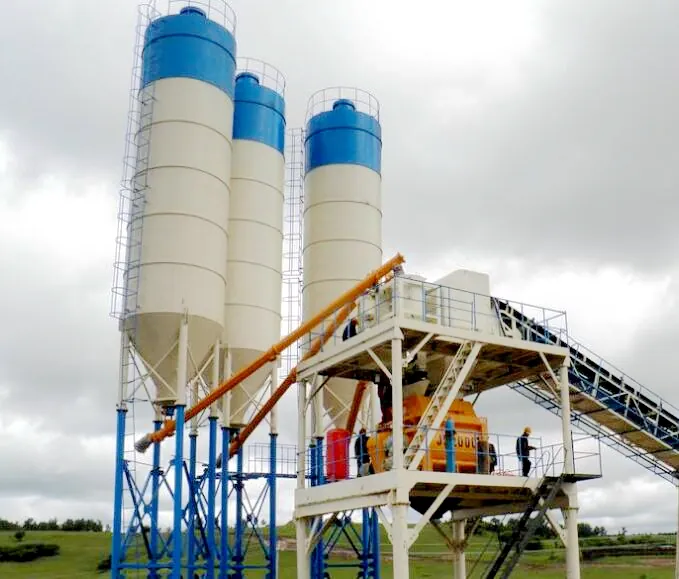
When a customer in Ghana, Ethiopia or Tanzania opens a batching plant quotation, the electrical drawing is usually not their first worry. Their first question is simpler: will this thing actually run on our power?
It is the right question, and it is the one that most often gets answered too late — after the container has arrived. A batching plant is a cluster of large motors, and how those motors start has more effect on your site than the plant's rated output. This guide covers the numbers you need before you place an order, not after.
Installed power by model
These are the installed (connected) power figures for the standard HZS range. Note the difference between installed power — what you must be able to supply — and average running draw, which is normally lower because the mixer does not run at full load all cycle.
| Model | Output (theoretical) | Mixer | Installed power | From price |
|---|---|---|---|---|
| HZS60 | 60 m³/h | JS1000 (37 kW) | 110 kW | $48,000 |
| HZS90 | 90 m³/h | JS1500 (45 kW) | 150 kW | $65,000 |
| HZS120 | 120 m³/h | JS2000 (55 kW) | 190 kW | $85,000 |
| HZS180 | 180 m³/h | JS3000 | approx. 260 kW | $120,000 |
| HZS240 | 240 m³/h | JS4000 (2 x 45 kW) | 400 kW | on request |
Voltage and frequency: say it before you sign
Chinese standard is 380 V / 50 Hz. That suits most of Africa, but not all of it:
- 380 V / 50 Hz — standard build, works across most of East and West Africa, the Gulf, and Central Asia.
- 415 V / 50 Hz — common on grids in parts of southern and eastern Africa. Motors tolerate the difference in practice, but control transformers, contactors and protection settings should be specified for 415 V.
- 440 V / 60 Hz — a genuine problem, not a rounding error. At 60 Hz a 50 Hz motor spins 20% faster and draws more current. This needs 60 Hz-rated motors, not a transformer.
Send your actual site voltage and frequency with the enquiry. It is a line on a form at that stage and an expensive retrofit later.
The starting current is what breaks sites
A 55 kW mixer motor started direct-on-line can pull five to seven times its rated current for a second or two. On a weak rural feeder that is enough to trip the breaker, brown out the neighbourhood, or stall every other motor on site. Three ways to deal with it:
- Star-delta starting — cheapest, cuts starting current to roughly a third. The standard build for most HZS plants.
- Soft starter — smoother, adjustable ramp, still commonly specified where the grid is poor.
- Variable frequency drive — best control and useful for tuning cycle times, but adds cost and a maintenance item that many remote sites cannot service.
Whichever you choose, tell us at order stage. Retrofitting a starter into a control panel on site is not a small job.
Sizing a generator
A genset must cover starting current, not just running load. The usual working rule is 1.3 to 1.5 times installed power with star-delta or soft start, and more with direct-on-line starting. Undersizing the genset is by far the most common mistake we see — the plant runs, but the generator stalls at the moment the mixer starts.
| Plant | Installed power | Practical genset size |
|---|---|---|
| HZS60 | 110 kW | 150–200 kVA |
| HZS90 | 150 kW | 200–250 kVA |
| HZS120 | 190 kW | 250–315 kVA |
| HZS180 | approx. 260 kW | 350–400 kVA |
| HZS240 | 400 kW | 500–600 kVA |
Round up, not down. A genset running at 70–80% load is efficient and long-lived; one running at 100% is neither.
What fuel actually costs per cubic metre
This is the number that decides whether diesel production is viable. A worked example, with the assumptions stated so you can substitute your own:
- HZS60 at 110 kW installed, running at roughly 70% average load = about 77 kW.
- Diesel gensets consume roughly 0.21–0.25 litres per kWh delivered, at sensible load.
- That is about 16–19 litres per hour.
- At 60 m³/h theoretical output — realistically 45–50 m³/h in service — that is roughly 0.3–0.4 litres of diesel per cubic metre of concrete.
At a diesel price of $1.10–1.40 per litre, fuel alone is around $0.35–0.55 per m³. Compare that with grid power in most of these markets and the conclusion is usually the same: use the grid whenever it is up, and keep the genset for outages. Your own figures will differ with load factor, cycle times and diesel price — the arithmetic above is a method, not a quotation.
Three configurations that work in practice
1. Grid only
Viable where supply is genuinely stable and the feeder can carry the starting current. Cheapest to run. Specify star-delta or a soft starter, and check with the utility what the feeder can deliver before you commit.
2. Grid plus backup genset
The most common arrangement in Africa, and usually the most economical overall. Add an automatic transfer switch so the plant does not sit idle waiting for someone to start the generator. Size the genset to carry the full plant — partial backup that cannot start the mixer is not backup.
3. Genset only
Common on remote project sites with no reliable feeder. Perfectly workable, but budget the fuel per cubic metre honestly into your tender price. Many projects lose money here because the bid assumed grid power that never arrived.
What to put in the purchase order
- Site voltage and frequency, measured at the plant location — not the city nominal.
- Starting method required (star-delta, soft starter, VFD).
- Control voltage — 24 V DC and 220 V AC are both available, and it matters for what your electrician can service.
- Cable runs from the transformer or genset to the control room, so cable sizing is not left to the site.
- Earthing arrangement, and whether an earth leakage device is required locally.
Frequently asked questions
Can a 380 V plant run on a 415 V supply?
In practice the motors tolerate it, but control transformers, contactors and protection settings should be specified for the actual site voltage. Declare 415 V at order stage rather than discovering it during commissioning.
How big a generator do I need for an HZS60?
Roughly 150–200 kVA with star-delta or soft starting. The figure is driven by starting current, not by the 110 kW running load.
Can I run the plant on a generator all day?
Yes, and many sites do. Budget roughly 0.3–0.4 litres of diesel per cubic metre at HZS60 scale, and size the genset at 70–80% load so it is not running flat out.
What if our power is 60 Hz?
The plant needs 60 Hz-rated motors. A transformer does not fix frequency. This has to be declared before production, not after delivery.
Does a soft starter increase the price much?
It is a modest addition against the total plant price, and it is far cheaper than upgrading a weak feeder or discovering during commissioning that the mixer trips the site breaker every cycle.
Tell Us Your Site Power
Send site voltage, frequency and whether you have a grid connection, and we will come back with the right configuration and starter type.
HZS60 — 60 m³/h, 110 kW, from $48,000
HZS90 — 90 m³/h, 150 kW, from $65,000
HZS120 — 120 m³/h, 190 kW, from $85,000
Request a factory quotation — reply within 24 hours